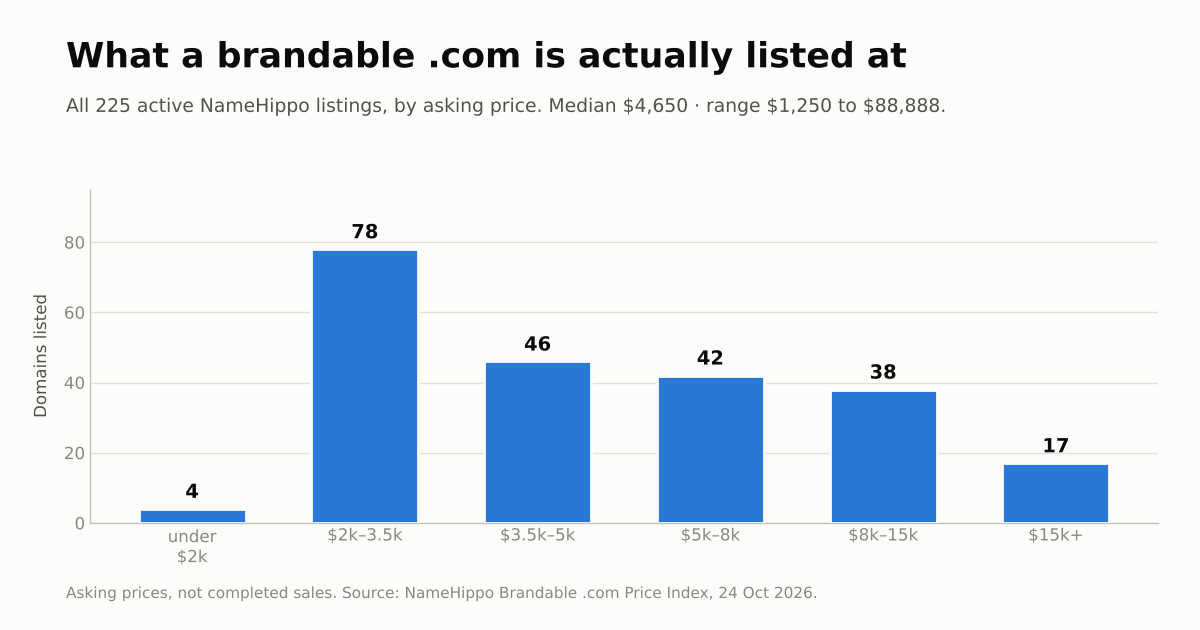
What a Brandable .com Actually Costs: 225 Asking Prices, Analysed
Short answer: across the 225 brandable .com domains listed on NameHippo in October 2026, the median asking price is $4,650. Half of all listings sit between $3,050 and $7,999. The lowest is $1,250 and the highest $88,888.
That is a narrow answer to a question usually met with anecdote. Most writing about domain pricing cites one famous sale and leaves the reader no better informed about what they will actually be asked to pay. The figures below are the complete distribution of a working inventory, published so you can check them.
The distribution
| Asking price | Domains | Share |
|---|---|---|
| Under $2,000 | 4 | 2% |
| $2,000 – $3,500 | 78 | 35% |
| $3,500 – $5,000 | 46 | 20% |
| $5,000 – $8,000 | 42 | 19% |
| $8,000 – $15,000 | 38 | 17% |
| $15,000 and above | 17 | 8% |
The shape is the useful part. This is not a smooth curve around an average; it is a mass of inventory in the low-to-mid four figures with a long thin tail. 128 of the 225 names, about 56 percent, are listed below $5,000.
Why the median, not the average
The mean asking price across the same 225 domains is $7,122 — roughly 53 percent higher than the median of $4,650. Nothing has changed except the statistic. A handful of names in the tens of thousands drag the mean upward, and any article quoting an average domain price without saying so is describing a number that applies to almost none of its inventory.
For a skewed distribution the median answers the question a buyer is actually asking: what will a name like this typically cost me?
What this does not prove
This is the part most pricing content leaves out, so it is worth stating plainly.
These are asking prices, not sale prices. An asking price records what a seller hopes to receive. Only a completed transaction records what a buyer agreed to pay. The two can differ substantially, and in a market where most sales are private, nobody — including us — has a complete picture of realised prices.
It is one inventory, not the whole market. These 225 names are curated for a particular kind of buyer: short, pronounceable, brandable .com names for companies that intend to grow. A portfolio built around expired traffic names or exact-match keyword domains would produce a different distribution entirely.
A distribution is not a valuation. Knowing that the median is $4,650 tells you where a name sits relative to its peers. It does not tell you what a specific name is worth to you, which depends on your category, your funding, and how much the alternative name would cost you in confusion over the next five years.
What actually moves the number
Within this inventory, the names in the upper bands tend to share a few properties:
- Length. Four and five-letter names cluster high. There are very few of them and no way to make more.
- Whether it is a real word. A pronounceable invented name is cheaper than a dictionary word, which is cheaper again than a dictionary word that also describes a profitable category.
- Syllable count and spelling risk. A name you can say once on a phone call and have the other person spell correctly carries a premium over one that needs explaining.
- Category. The same construction is priced differently in lending than in, say, hobby software, because the buyer's economics differ.
These are observations about how this inventory is priced, not laws of the market.
How to use this as a buyer
Three practical uses:
- Calibrate before you negotiate. If you are quoted $12,000 for a name, you now know that puts it in the top quarter of a curated brandable inventory. That may be entirely justified — but you should know where you are standing.
- Budget against the band, not the anecdote. If you have read about a six-figure sale and concluded you cannot afford a
.com, the distribution above says otherwise for most categories. - Ask what a completed sale looked like. Any seller quoting market comparables should be able to say whether they are citing asking prices or realised ones. The distinction is the whole game.
The underlying data
The figures here come from our Brandable .com Price Index, which publishes the medians and quartiles as an open dataset with JSON and CSV downloads under a CC BY 4.0 licence. It suppresses any category with fewer than five listings, because a median computed from two names is noise wearing the costume of data.
If you want to check this article, the dataset is the place to start. If you find an error in it, we would like to know.