When Your Extension Depends on a Country: What the .io Question Means for Founders
Short answer: as of October 2026, .io is live and unaffected. Registrations continue, the registry operates normally, and there is no ICANN retirement notice. If you own a .io domain, nothing requires action today.
The reason it is worth writing about anyway is that the episode made visible a dependency most founders never knew their domain had.
What raised the question
On 3 October 2024 the British government announced it would transfer control of the Chagos Islands to Mauritius. The .io extension derives from the ISO 3166 country code for the British Indian Ocean Territory.
Because country-code extensions are tied to codes on that list, and because codes change when territories do, the announcement raised an obvious question: what happens to .io?
What has actually happened since
Very little, and that is the honest reporting.
- No formal request has been made to reassign or retire the code.
- The ISO 3166 Maintenance Agency cannot remove a code on its own initiative. It acts on official requests.
- Even if a code is withdrawn, it can be placed on the exceptionally reserved list — a status that would keep the extension eligible to continue.
- ICANN has issued no retirement notice.
Registrars tracking this put the near-term risk as very low. On the evidence available, that looks right.
We should flag the limits of our own sourcing: the clearest public summaries come from registrars, who are not disinterested parties and who do not generally link to primary ISO or ICANN documents. We have not found a primary source that contradicts them, but we have not found one that confirms the detail either.
The part that is actually useful
The forecasting question — will .io survive? — is the less interesting one, and nobody can answer it honestly.
The structural question is better: what does your domain's continued existence depend on?
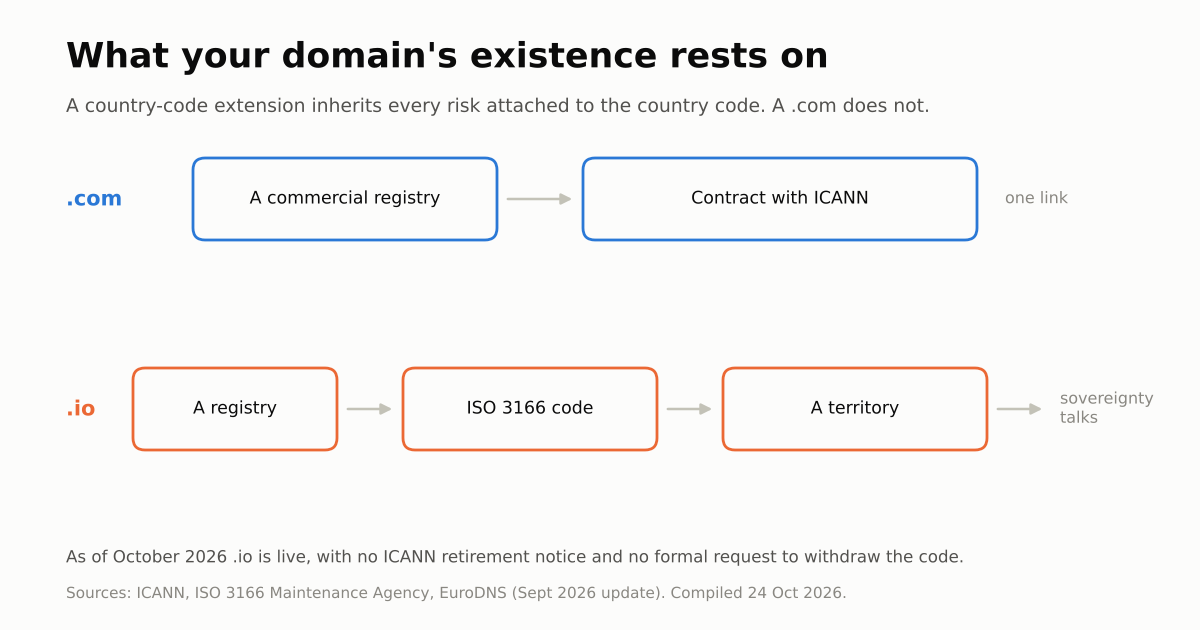
A .com depends on a commercial registry operating under an ICANN contract. One relationship, governed by commercial agreements, with no connection to any country's political status.
A country-code extension depends on that same registry arrangement, plus a code on the ISO 3166 list, plus the continued existence and status of the territory that code refers to. Three links instead of one, and the extra two sit entirely outside the commercial world your company operates in.
For most founders using .io, this has never mattered and probably never will. But it is a real difference, and before October 2024 almost nobody choosing .io for a startup had considered it at all. The extension was chosen because it reads as "input/output" to engineers — a happy coincidence of letters, with the geography an irrelevance nobody looked at.
What a forced move actually costs
The common reassurance is that retirement would come with years of notice. True, and it misses where the cost lands.
A domain is not only an address. It is every inbound link anyone has published, every email address on every business card and contract, every integration configured by a customer, every OAuth callback, every printed asset, and the thing people type from memory. Moving it is a project, and some portion of traffic and trust never arrives at the new address.
This is why companies that can afford it tend to consolidate on .com before they are forced to. Technology press reported in April 2025 that Scale, Modular, Pymetrics, Pickle and Mentessa had each moved from a .ai address to the matching .com. Acquisition prices were not disclosed, so what those moves cost is not public — but a company does not undertake a domain migration for aesthetic reasons.
So should you avoid .io?
Not on these facts. The near-term risk is low and we are not going to inflate it; we sell .com domains, which is exactly why we should be careful not to overstate a competitor's problem.
What we would say is narrower:
- Know what you are standing on. If your extension is a country code, your brand has a dependency on that country's circumstances. Usually dormant. Not absent.
- Price the migration, not the probability. The useful question is not "will this happen" but "what would it cost me if it did, and when would that cost be lowest?" The answer to the second part is almost always now, while you are small.
- Separate the signal from the asset. Extensions signal things —
.iosays technical,.aisays artificial intelligence. Signals age. The address has to outlast the signal.
If you are early enough that moving would cost a weekend rather than a quarter, that is the cheapest this decision will ever be.
Where this stands
We will update this page if the position changes. As things stand in October 2026: .io is operating normally, no retirement has been requested or scheduled, and the mechanisms that would be needed to end it have not been engaged.
The question it raised is still worth having asked.