The Extension Backed by Microsoft, Nokia and Visa — and What Actually Ended It
Short answer: .mobi launched in 2005 with backing from Microsoft, Nokia, Samsung, Ericsson, Vodafone, Visa and the GSM Association — each with an executive on its board. It was not defeated by a competing extension. It was made redundant by responsive web design, a technique that removed the problem it existed to solve.
That is the most useful case study in domain strategy, because it is the failure mode nobody prices in.
What it was for
In 2005, a phone browser and a desktop browser were genuinely different environments. Screens were tiny, connections slow, and a desktop page was close to unusable on a handset. The proposed answer was a separate mobile web: build a second site, serve it from a distinct extension, and let the address itself tell the browser what it was getting.
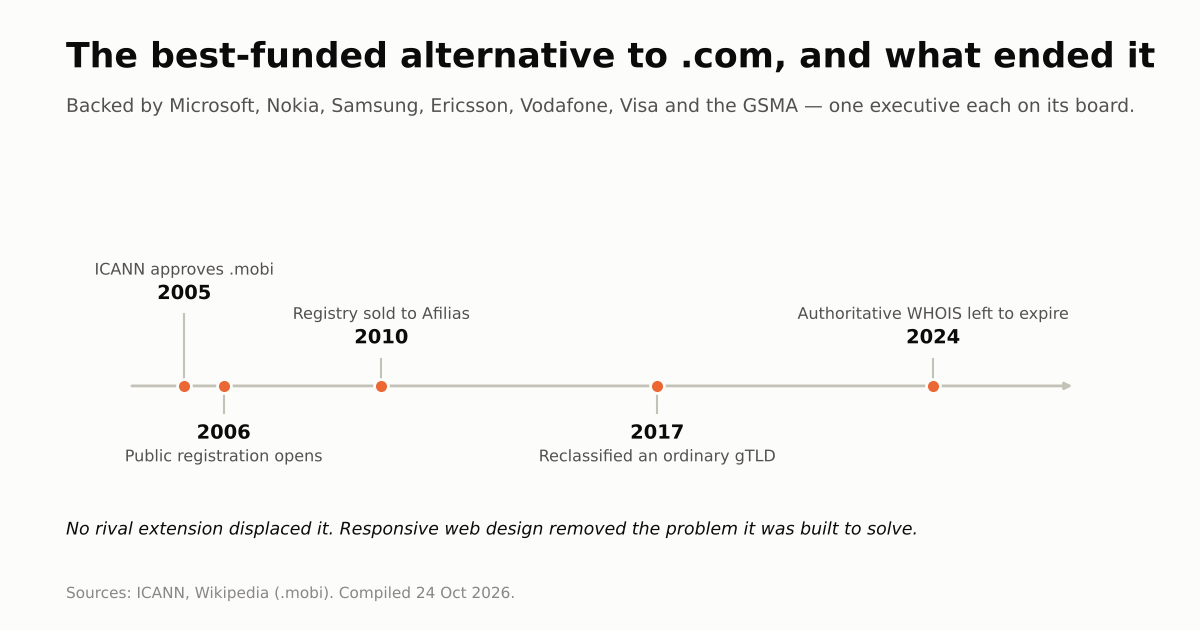
ICANN approved .mobi on 11 July 2005. Public registration opened on 26 September 2006. The registry worked with the W3C Mobile Web Initiative on best practices for mobile content.
The backing was extraordinary. Microsoft, Nokia, Samsung, Ericsson, Vodafone, T-Mobile, Telefónica Móviles, Telecom Italia Mobile, Orascom Telecom, Hutchison Whampoa, Syniverse and Visa, alongside the GSM Association. If institutional support determined outcomes, .mobi would have won.
The objection at the time
Tim Berners-Lee criticised the extension on the grounds that it would produce redundant content — the same material at two addresses, split by device.
This was a design argument, not a commercial one, and it was the correct one. The question was never whether phones needed different layouts. It was whether that difference belonged in the address.
What actually happened
The answer arrived from an unrelated direction. Responsive web design — one site, one address, a layout that adapts to the screen — made the second site unnecessary. Not inferior. Unnecessary.
A company with a responsive .com had no reason to maintain a parallel .mobi. The extension was not outcompeted; the category it belonged to stopped existing.
What followed was quiet. Afilias acquired the registry in February 2010. In March 2017 .mobi was reclassified as an ordinary generic top-level domain, operating on the same terms as any other. In 2024, its old authoritative WHOIS server was allowed to expire — a lapse that researchers showed could have enabled fraudulent certificates to be issued.
Domains in .mobi still resolve. People still register them. But the thesis it was launched on is gone, and the companies whose executives sat on its board run their businesses on .com.
The lesson, stated precisely
It is tempting to read this as "alternative extensions fail". That is the wrong lesson, and it is not what happened.
The right one is narrower: an extension that encodes a technical assumption inherits the lifespan of that assumption. .mobi assumed the mobile web would stay separate. When that stopped being true, the extension had nothing left to mean.
This is why .com keeps outlasting its replacements. It is not better engineered and it carries no inherent ranking advantage. Its durability comes from making no claim at all. It does not assert that you are mobile, or a technology company, or artificial-intelligence-based, or located anywhere in particular. There is no trend whose passing can strand it, because it never attached itself to one.
The question to ask instead
Not "is this extension popular?" — .mobi was, briefly, with the largest phone companies on earth behind it. Ask instead:
- What is this extension betting on? A technology, a trend, a country, a category — or nothing?
- What happens to my brand if that bet stops being true?
- Would I still want this address if the thing it signals became unremarkable?
Plenty of companies answer those questions and reasonably pick something other than .com. A deliberate choice with the risk understood is a strategy. Choosing an extension because it currently signals that you are modern is how founders end up explaining a rebrand three years later.
.mobi was the most heavily funded attempt to date, and the thing that ended it was not a rival. It was a stylesheet technique.